



 Login
Login
 Tiếng Việt
 日本語
日本語Continuing our series of analyses on the National Logistics Strategy FWC 2025, we have clearly visualized the four-pillar picture the government is aiming for. However, a major question remains open: how do we operate smoothly when the market is constantly full of fluctuations?
At Panel 4 of FWC 2025: “Building Agile and Resilient Supply Chains,” a powerful message was affirmed. “Sustainability” and “Agility” are no longer optional add-ons; they have become prerequisites for realizing the national strategy.
Below are profound analyses of the vital role these two key factors play across the four important pillars.
Infrastructure & Trade Facilitation: “Soft Infrastructure” is the Prerequisite for Agility
Decision 2229/QD-TTg sets a goal to build at least 05 modern, international-scale logistics service centers by 2035. However, if businesses only focus on the scale of warehousing or fleet size, the apparatus will become cumbersome and ill-adapted. WR1 has previously analyzed that “Soft Infrastructure”—comprising synchronized mechanisms and processes—is the “operating system” that determines actual performance. In the new context, this is the prerequisite creating the necessary agility for the entire national logistics system.
The clearest proof of this view comes from Mr. Peter Lim, Vice Chairman of the Singapore Logistics Association, at the conference. He shared that Singapore plans to expand seaport capacity to 65 million TEUs within the next 20 years. They dare to invest heavily in hard infrastructure because they possess a solid soft infrastructure foundation based on public-private partnership. This consensus helps Singapore build infrastructure with a “Just-in-Case” (preparedness) mindset, ensuring flexibility against all growth scenarios. Notably, reserving up to 65% of capacity for the cold chain demonstrates a flexible shift toward high-value and sustainable niche markets.
From this perspective, Vietnamese Forwarders need to shift their strategy from spread-out investments to focusing on building solid soft capabilities. Focus on standardized processes and specialized knowledge to develop niche services, such as logistics for specific goods preservation.
Mr. Nguyen Quang Vinh from VCCI also emphasized the importance of policy in creating conditions for these sustainable practices. A logistics corridor that wants to adapt quickly needs an open mechanism and reliable companionship between the Government and the business community.
Digitalization & Innovation: Forecasting Capability is the Prerequisite to Surpass the “Critical Threshold”
The national strategy has set a target for 80% of logistics enterprises to effectively use digital transformation solutions by 2035. This figure is not just a technical indicator but a prerequisite for achieving agility in the new context. WR1 once analyzed the “Critical Threshold” (or Death Point)—where logistics costs hit 50% of the product price due to the manual handling of millions of small orders. The difference between traditional container cargo and e-commerce demands high data management capabilities that old methods cannot provide.
To avoid hitting this dangerous “critical threshold,” Panel 4 affirmed that digitalization is a mandatory condition to possess accurate forecasting capabilities, thereby leading to adaptability:
Regarding forecasting: Singapore is applying Digital Twins to anticipate risk scenarios and avoid incurred costs.
Regarding adaptability: Turkish Cargo proved they could open a new flight route in just three days thanks to their data system. This rapid pivot ability shows that transparent data is the critical basis for businesses to make instant decisions.
Clearly, digital transformation is no longer just a fancy slogan but a condition for survival to control costs and maintain flow. Mr. David Yokeum – Chairman of WCAworld – also reminded us that technology is the platform, but human trust and communication are the glue that binds the network. Only when combining modern technology with the human element can supply chain agility truly achieve optimal efficiency.
Green Logistics & Sustainability: Resilience is the Prerequisite for Survival
The government aims to develop green logistics and reduce emissions toward Net Zero in Decision 2229 with an ambitious vision. Many businesses view this as a cost burden, but reality proves that sustainability is a prerequisite for supply chain survival. Mr. Nguyen Quang Vinh – Vice Chairman of VCCI – cited Typhoon Yagi in Hanoi as a profound wake-up call regarding the impact of climate change. He emphasized that “Greening” is not just a social responsibility but the only way to increase resilience for businesses.
Lacking this core element, the supply chain will easily break in the face of increasingly fierce environmental risks. Agreeing with this view, Mr. David Yokeum noted that the world is shifting its mindset from “Just-in-Time” to “Just-in-Case”. This change aims to optimize long-term safety rather than solely focusing on short-term efficiency as often seen before.
To realize this prerequisite without financial pressure, Forwarders need to maximize the use of green credit mechanisms. VCCI is working to promote these financial resources to support businesses in transitioning to more sustainable operating models. Investing in sustainable vehicles and warehousing is essentially how businesses buy long-term insurance for their own future. This is how to turn challenges from Decision 2229 into core competitive advantages in a volatile logistics market.
Capacity & Human Resources: “Mastering the Basics” is the Prerequisite for Adaptation
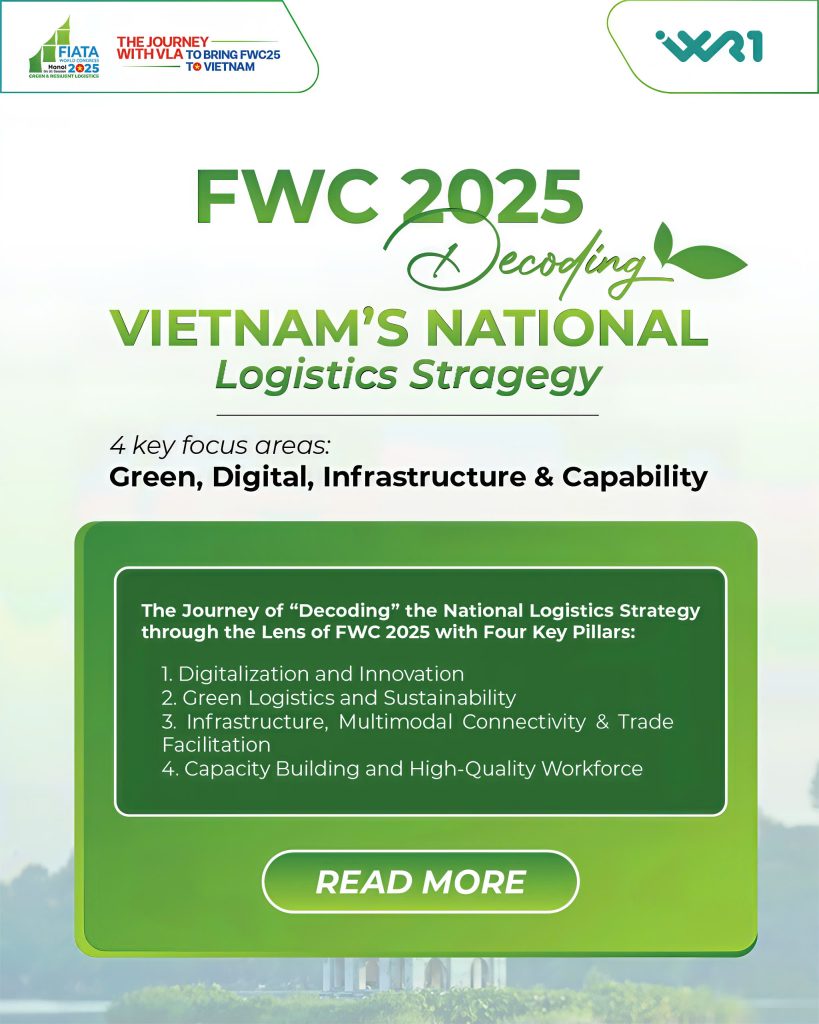
To smoothly operate the three pillars of Infrastructure, Digitalization, and Greening, the human element always plays the central and most important role. Decision 2229 targets 70% of the workforce to be professionally trained by 2035, a major challenge in the era of automation. However, the question arises: what kind of capability is the prerequisite for personnel to be flexible in the face of change? The advice from Mr. Mike Reid of Central Retail Group at the conference was very practical and valuable:
“Master the basics before going big.”
Many businesses are busy chasing flashy technologies like Blockchain or AI while forgetting the core operational management foundation within. Mr. Mike Reid emphasized that to adapt to new technology, personnel must master the industry’s most critical operating principles. Understanding cost per unit and flow speed is the prerequisite to mastering tools in the most flexible way.
He also shared about Central Retail’s “Supply Chain Academy” model, where personnel are retrained from traditional mindsets to modern ones. This is not just a place to provide knowledge but a crucible for employees to adapt to a new, high-pressure working environment. Only when solid from the roots can Vietnamese logistics personnel have the bravery to customize and adapt quickly. This helps them stand firm against market fluctuation waves and meet the true spirit of the strategy proposed by the Nation.
WR1: Accompanying Forwarders in the New Opportunity
As an industry practitioner, WR1 understands that Decision 2229 is not just a directive document, but a signal for a major shift in the entire national logistics system. We choose to accompany this strategy through Rapid Adaptation and Green Thinking.
At FWC 2025, we did not play the role of observers, but connectors of knowledge. WR1 brings practical combat stories from Singapore, Turkish Cargo, or Central Retail back to share with the community. We want Vietnamese Forwarders to see what we are seeing:
- See the importance of preparing infrastructure and processes (like Singapore does).
- See the power of data in forecasting risks.
- And see that “Green Logistics” is the passport to the future.
With the positioning “Neutral for Forwarder”, WR1 will continue to be a companion, providing thought-provoking information and the most practical lessons. We believe that when the Forwarder community clearly recognizes the problem and the opportunity, we will turn this “once-in-a-lifetime” opportunity into the true power of Vietnam Logistics.
As concluded at the conference: “Agility and sustainability need to move from theory to proactive action.” Let’s start that proactivity by changing our mindset today.
Read more:
References: Synthesized by the author from discussion sessions at the FWC 2025 Conference.

 Tiếng Việt
 English